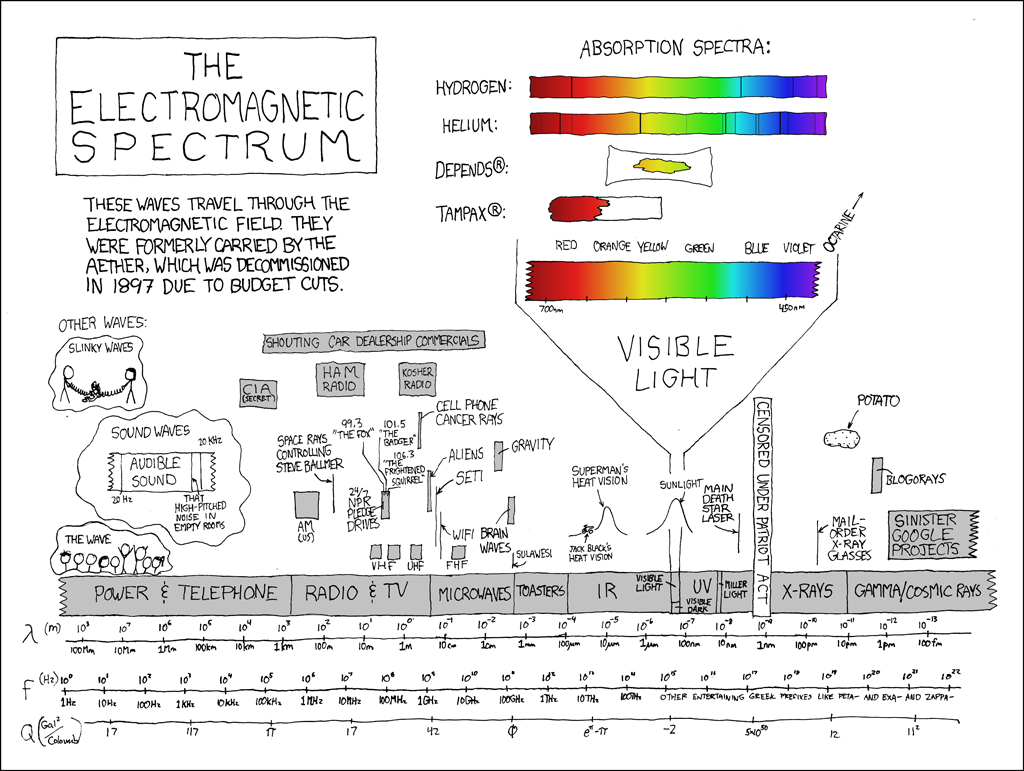
Just because it has some spillover into visible light doesn't mean that's where the majority of its power is. It's also possible that the visible light is actually produced by a secondary process such as ionization of the material it passes through, or Cherenkov radiation, or Compton scattering, or something else like that.
I will not argue with an actual physicist. I will ask a few questions, though:
(1) It's passing through hard vacuum. Can there be enough material there to ionize that you'd be able to see it? (Same argument seems to apply to Compton scattering.)
(2) Isn't Cerenkov radiation blue?
(And yes, I know, if it _were_ a laser we wouldn't be able to see the beam from the side in a vacuum in the first place.)
You know, (1) makes me think...let's suppose that you _wanted_ to create a visual effect like that of the Death Star Laser in hard vacuum. How could it be done?
1, 3) In a real true complete vacuum? Don't think it could be done.
However, this's just interplanetary space, it's not a true vacuum (to an astronomer). Probably more of a vacuum than what we can do in a lab on Earth, but still, there's enough stuff there that some of my ideas aren't completely impossible. There's enough stuff that that it glows to the naked eye even (see zodiacal dust and zodiacal light), so I'm sure with a little work some engineer could really make that effect happen.
I'd call the space between galaxies a vacuum, but within a solar system and between planets is positively dense, and even between stars within a galaxy has got enough dust that it's problematic for astronomers to look in those directions in our Milky Way.


![[identity profile]](https://www.dreamwidth.org/img/silk/identity/openid.png)
![[personal profile]](https://www.dreamwidth.org/img/silk/identity/user.png) timeasmymeasure
timeasmymeasure
no subject
Date: 2008-03-04 05:10 pm (UTC)no subject
Date: 2008-03-04 05:17 pm (UTC)(1) It's passing through hard vacuum. Can there be enough material there to ionize that you'd be able to see it? (Same argument seems to apply to Compton scattering.)
(2) Isn't Cerenkov radiation blue?
(And yes, I know, if it _were_ a laser we wouldn't be able to see the beam from the side in a vacuum in the first place.)
You know, (1) makes me think...let's suppose that you _wanted_ to create a visual effect like that of the Death Star Laser in hard vacuum. How could it be done?
no subject
Date: 2008-03-04 05:35 pm (UTC)Plasma!
no subject
Date: 2008-03-04 05:56 pm (UTC)Yeah, as I said, ask an engineer. :)
no subject
Date: 2008-03-04 06:33 pm (UTC)You'll notice that "lasers" in Star Wars have perceptible travel times, meaning they can't actually be lasers. Clearly, they are plasma slugs.
no subject
Date: 2008-03-04 05:55 pm (UTC)1, 3) In a real true complete vacuum? Don't think it could be done.
However, this's just interplanetary space, it's not a true vacuum (to an astronomer). Probably more of a vacuum than what we can do in a lab on Earth, but still, there's enough stuff there that some of my ideas aren't completely impossible. There's enough stuff that that it glows to the naked eye even (see zodiacal dust and zodiacal light), so I'm sure with a little work some engineer could really make that effect happen.
I'd call the space between galaxies a vacuum, but within a solar system and between planets is positively dense, and even between stars within a galaxy has got enough dust that it's problematic for astronomers to look in those directions in our Milky Way.