I totally wanted to reply to this, but there isn't enough space in 140 characters.

There's this idea in physics of the order of magnitude (OOM) calculation, sometimes also called a back-of-the-envelope calculation. The idea is that you can calculate a rough number (OOM) for a very abstract concept with just making a few assumptions at the beginning and doing a very small bit of math. The classic story is that Feynman calculated the number of piano tuners in Chicago on the back of an envelope.

So let's say that a typical Batman cartoon episode takes place over a single day of real time. Let's further presume that in a typical episode, a villain breaks one window, and Batman breaks a second. If a repairman takes a half day to replace a window, then Gotham would need exactly one glass repairperson to account for the city's villains and heroes. Any additional window breakage would require either overtime on the first glass repairperson's part, or else additional glass repairpersons.

Originally posted on Dreamwidth. comment count unavailable comments there. Comment here or there.
A quick survey for those following along at home. Please complete the survey before checking others' responses or comments below.

[Poll #1817087]
Does anyone have a source for cow stickers? Amazon seems to only have third party vendors, and the best I could find on Oriental Trading were mixed barnyard animals. I want cows. Only cows.

Wiki needed

Jun. 1st, 2010 10:42 pm
asterroc: (Astro - H-alpha)
I'm looking for a wiki that allows entering and editing complex math formulae (like Mediawiki, I don't care if it's WYSWYG or LaTeX-like), but hosted on their servers (like PBWorks) for an online Physics course that I'm developing for the Spring. My goal is to have the students collaboratively write their own outlines and study sheets.
asterroc: (xkcd - Fuck the Cosine)
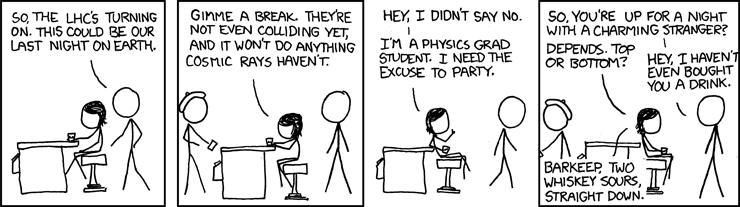
xkcd - click for original comic and alt-text

I love that I now have an LHC tag.

DanJosef (in case you're following this now via RSS): This could be our last night on Earth! And Dan's too! Twice!
The Large Hadron Collidor goes online today! This is as exciting as the day Hubble opened its shutters May 20 1990.

Even a lot of sciencey people I know have been asking about what the LHC is, and why the doomsayers are wrong, so here's a little summary of it. Particle accelerators (as is the LHC) are devices that smash things together to find out what's inside them. It's somewhat like if we wanted to learn how cars work, so we did head-on crash tests. While the analogy isn't perfect (no analogy ever is), there are some similarities. For example, while head-on crashes in real life are dangerous, crash tests are completely controlled and are entirely safe. Particle accelerators let us learn about what's going on inside small particles. Older lower energy ones smashed together "normal" particles like electrons and protons and helped us to learn that those are made of quarks. The LHC is a high energy one and we'll be smashing together another type of particle called a hadron, and it will help us learn how the entire universe works, for example gravity and dark matter.

The woo-hoos (aka tinfoil hat wearers) have been saying doom and gloom about the LHC, claiming that the high energy levels will either rip a hole in the entire universe, or else create a black hole that will swallow the Earth. Well, there's really no reason to worry at all. First off, we only call the LHC "high energy" by comparison - it's higher energy than anything people have been able to do before now. However, much higher energy collisions take place every second as cosmic rays hit the Earth's atmosphere. The main difference is that in the LHC these collisions are controlled. As I said to a biologist in another community, being afraid of that is kinda like if people were afraid of scientists culturing e.coli - it happens in the wild, after all, and that's not scary at all.
If you've already beaten Magic Pen and loved it, then you have to give Fantastic Contraption a shot. It's another cartoon physics game, this one based on wheels and levels.
In case anyone's interested, I thought I'd post some answers to the quiz questions I posted the other day asking people for help in timing online quizzes.

Regarding the timing issue, everyone reported that it took them a very short time to type their answers - admittedly it's a self-selected group (I doubt slow typers would enjoy blogging all that much, and people who hate science probably wouldn't be answering these questions for me), but still it gives me a starting point. My plan with my class is to (a) ask students during the first week about their typing skills, (b) unless any of their answers worry me, I'll give the same amount of time for the first quiz as I would give in a face-to-face class, (c) I'll look at the statistics of how long it took them to complete the quiz and adjust subsequent quizzes accordingly.

So, for the answers )


Once again, thanks for the help!

X-posted
It is worth noting that for all vehicles that travel on wheels (such as cars and bicycles), the sum of rolling resistance and static friction is what causes the vehicle to slow when the brakes are applied. The actual force applied in braking (for example, clamps applied to disk brakes) is internal, and by Newton's First Law cannot cause a change in the vehicle's motion. [Source]


I added that to the (English) Wikipedia page on rolling friction, and it's now been called into question on the Polish version of the page. [livejournal.com profile] kadath or anyone else got a good resource I can use to back me up on that here? My explanation is below, but I'd really like an external confirmation on it to fit the way Wikipedia works.

The issue is that you need to take the car as a whole, that is the body of the car, plus the brakes, plus the wheels. This is the body. Newton's Laws say that the sum of the external forces (also called the net force) causes a change in the body's motion (Law #1), and this sum of forces is equal to the mass times the acceleration (law #3, ΣF = ma). When you draw a Free Body Diagram, all you draw are the external forces, not what's going on inside.

Consider Newton's Second Law in this context, that every action has an equal and opposite reaction. In this case, we can think of the two bodies as the brake pads and the disk of the brake itself. Whatever force the brake pads are applying to the disk is equal and opposite of the force the disk is applying on the brake pads. These cancel out, and the center of mass of the two objects will be unaffected. Compare it to the Earth and the Moon - they apply equal and opposite forces of gravity upon each other, and so their center of mass will not accelerate due to those two forces alone. You need an external force to cause a change in motion, and in the case of the car it's friction between the tires and the road (rolling or kinetic, depending upon whether the wheel is rolling or sliding).
asterroc: (Astro - H-alpha)
It's a spherical cow!


At $38 and more than a foot approximately 42 centimeters in diameter, that's approxmiately 0.7¢/cm3! A total bargain!

And now some people are laughing, and other people haven't taken physics. I am *so* cross-posting this to [livejournal.com profile] physics.

*glee!*

Sep. 6th, 2007 08:58 am
OMGOMGOMG, the air tracks came in yesterday! I've only been working since 2004 to try and get these things! I've got physics lab this afternoon; we're going to unpack and possibly assemble them. *bounces*


For your entertainment, on the page I found it, it said "Vector physics in real life. From 'Trivia no Izumi' (Fountain of Trivia), the same Japanese show that figured out how heavy a fish Dora cat can carry."

For your edification, what's happening is the truck is driving forward (left) at 100km/hr, while the ball is being shot backwards (right) at (-)100km/hr relative to the truck. Note in particular the strobe effect photos of the ball shot from a stationary truck at 1:40, and the ball shot from the moving truck at 3:50. Also note that while the ball falls it drifts forward slightly, this could be due either to a mismatch in velocities or due to drafting (wind following the motion of the truck), and after it impacts the ground it bounces forward significantly, probably due to spin ("English") on the ball or possibly due to drafting (since the video is sped back up we can't tell how fast it's moving forward compared to while it was falling).

Link c/o [livejournal.com profile] hitchhiker.

Profile

asterroc

April 2017

S M T W T F S
      1
2345678
9101112131415
16171819202122
232425 26272829
30      

Syndicate

RSS Atom

Most Popular Tags

Style Credit

Expand Cut Tags

No cut tags
Page generated Dec. 24th, 2025 10:39 pm
Powered by Dreamwidth Studios